
The Day the Waxer Went Quiet: What Desktop Publishing Can Teach Us About AI in marketing
It's a Tuesday afternoon in 1983, and somewhere in an ad agency production room, someone is trying not to crack the letter C.
The headline is set in Helvetica Bold, 36 point, and it's coming together one character at a time off a sheet of Letraset, the dry-transfer lettering you would buy for about four dollars a sheet. Each letter was a thin film you position by eye and rub down with a burnishing tool until it releases onto the board. Letraset had been the workhorse of agency production since the early 1960s. By the early 1980s it was everywhere: design studios, architecture firms, ad agencies, anyone who needed clean type on a layout and didn't have three days to wait for it. Its whole appeal was that it required no machine at all. Just a steady hand, a burnishing stick, and enough sheets in the flat file to survive a bad week.
That was the fast option. The slow option was real typesetting, and "real" meant sending your copy out to a speciality shop.
The Old Workflow
If the job needed body copy, or type in a size and precision Letraset couldn't give you, you marked up the manuscript with a red pencil denoting typeface, point size, leading, and column width, and then sent it to a typesetting house. A day or two later, a bike messenger or the mail brought back galleys: long strips of photographic paper with your copy set in "cold type," the term for anything that wasn't cast in hot metal on a Linotype machine. If there was a typo, or the client wanted the subhead two points larger, that strip went back out and you waited again. Every round of corrections was a full round trip.
Once you had your type, the real labor started: paste-up. An artist would run the galleys through a waxer, which was a machine that coated the back of the paper with a thin layer of hot adhesive wax. They would then position each strip on a board using a light table, a T-square, and a steel ruler, trimming with an X-Acto knife and squaring everything up by eye. Border tape stood in for hairline rules. A non-repro blue pencil, invisible to the stat camera, marked guides that would never show up in the final shot. When the board was done, it was called a mechanical, and a stat camera would photograph it to produce the film the printer needed to make plates. Bestine solvent cleaned the wax off your hands at the end of the day, which tells you something about how much of it ended up there.
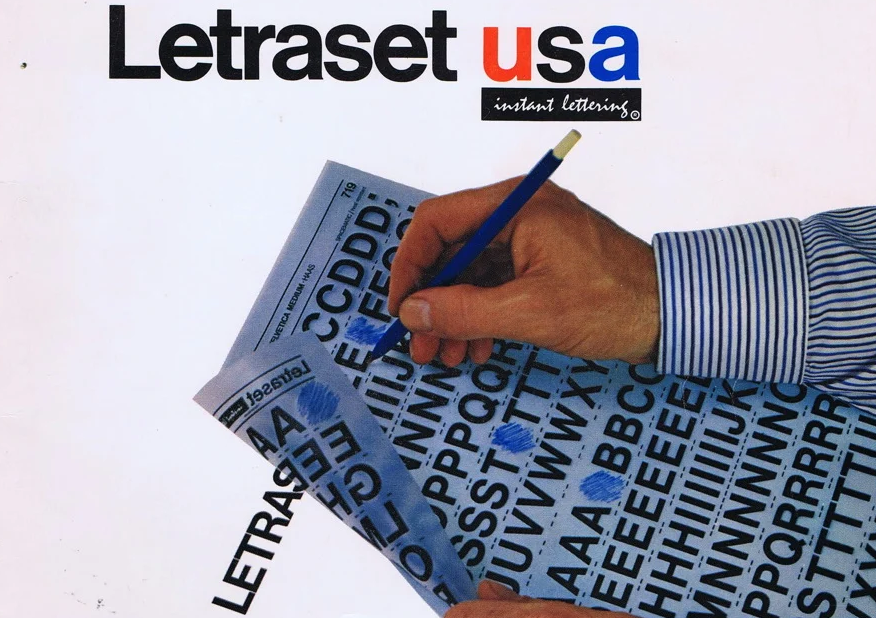
Make it stand out
This wasn't sloppy work. It was a real craft, with real specialists like paste-up artists, compositors, and typesetting houses that existed as entire businesses. They were all built around the fact that setting and placing type by hand was simply what it cost to make an ad.
The Six Months That Changed It
Then, in a span of about eighteen months, the ground moved.
In January 1984, Apple shipped the Macintosh for $2,495. In January 1985, it announced the LaserWriter retailing for $6,995, a genuinely absurd price for a printer. The cost was justified by the fact that it spoke PostScript, Adobe's page-description language, and could print actual typeset-quality pages instead of dot-matrix garbage. And in July 1985, a small Seattle company called Aldus shipped a program called PageMaker for the Mac. Its founder, Paul Brainerd, needed a name for what the combination of these three things let you do, and the phrase he landed on was "desktop publishing." InfoWorld reviewed PageMaker that September and put it about as plainly as a trade magazine ever does: "if your group owns a LaserWriter, you've got to own PageMaker."
What that combination actually did was collapse the round trip. A correction that used to mean a phone call, a messenger, and a day of waiting now meant retyping a line and hitting print. The typesetting house's whole value proposition of turning marked-up copy into type was suddenly something a designer could do at their own desk, in minutes, as many times as they wanted, for free.
What Actually Happened Next
Here's the part worth sitting with: it didn't happen instantly, and it didn't happen evenly.
Typesetting houses didn't vanish in 1985. Plenty hung on for years doing high-end work desktop tools couldn't yet match. But the writing was legible fast, and by the early 1990s the standalone typesetting business had largely disappeared, absorbed into agencies and print shops that now did it themselves, in-house, as a byproduct of design rather than a separate purchase. Letraset saw the same wall coming and tried to climb it, pivoting into design software of its own. It didn't work. The company that had built its business on doing type by hand couldn't out-execute the industry that had just made doing type by hand optional, and it spent the following years being sold, absorbed, and eventually reduced to a name nostalgic designers put on tote bags.
The people who struggled most were the ones whose entire value was the manual labor itself. The people who thrived were the ones whose real value had always been somewhere else: an eye for type, a sense of hierarchy and layout, taste. They didn't stop being valuable when the tools changed. They just stopped spending Tuesday afternoons burnishing a headline by hand, and started spending it on the fourteen other things a designer actually does.
The Same Shape, Forty Years Later
I don't think what's happening with AI in advertising right now is a new story. I think it's the same story, wearing a different decade's clothes.
The panic sounds identical, if you squint: a technology shows up that does, in minutes, what used to require a specialist, a vendor, and a waiting period. The tasks it's coming for are the production tasks like first-draft copy variations, resizing a campaign across nine ad formats, rough layout iterations, basic image production, etc. It’s the modern equivalent of setting type and running the waxer. Necessary work. Skilled work, even. But work that was always going to be automated the moment the technology existed to do it, because its value was in the execution, not the judgment behind it.
The strategist who knows why a headline needs to say one thing instead of another is not the paste-up artist. The account person who understands what a client is actually afraid of is not the typesetting house. Those roles were never manual labor. They were always the taste and the judgment that manual labor served. AI is not coming for that any more than PageMaker came for the art director's eye. It's coming for the waxer.
We built FullStack on that bet. Let the machine do the machine's work, and spend the money you save on the parts that were never really about typing fast in the first place. The strategist still writes the brief. The AI just doesn't need a bike messenger to get the type back.
Somewhere there's still a burnisher in a drawer at an old agency, and somewhere there's a designer who could tell you exactly how it felt in your hand. Neither of them are coming back. That's fine. Nobody actually misses the waxer. They miss what it let them make.